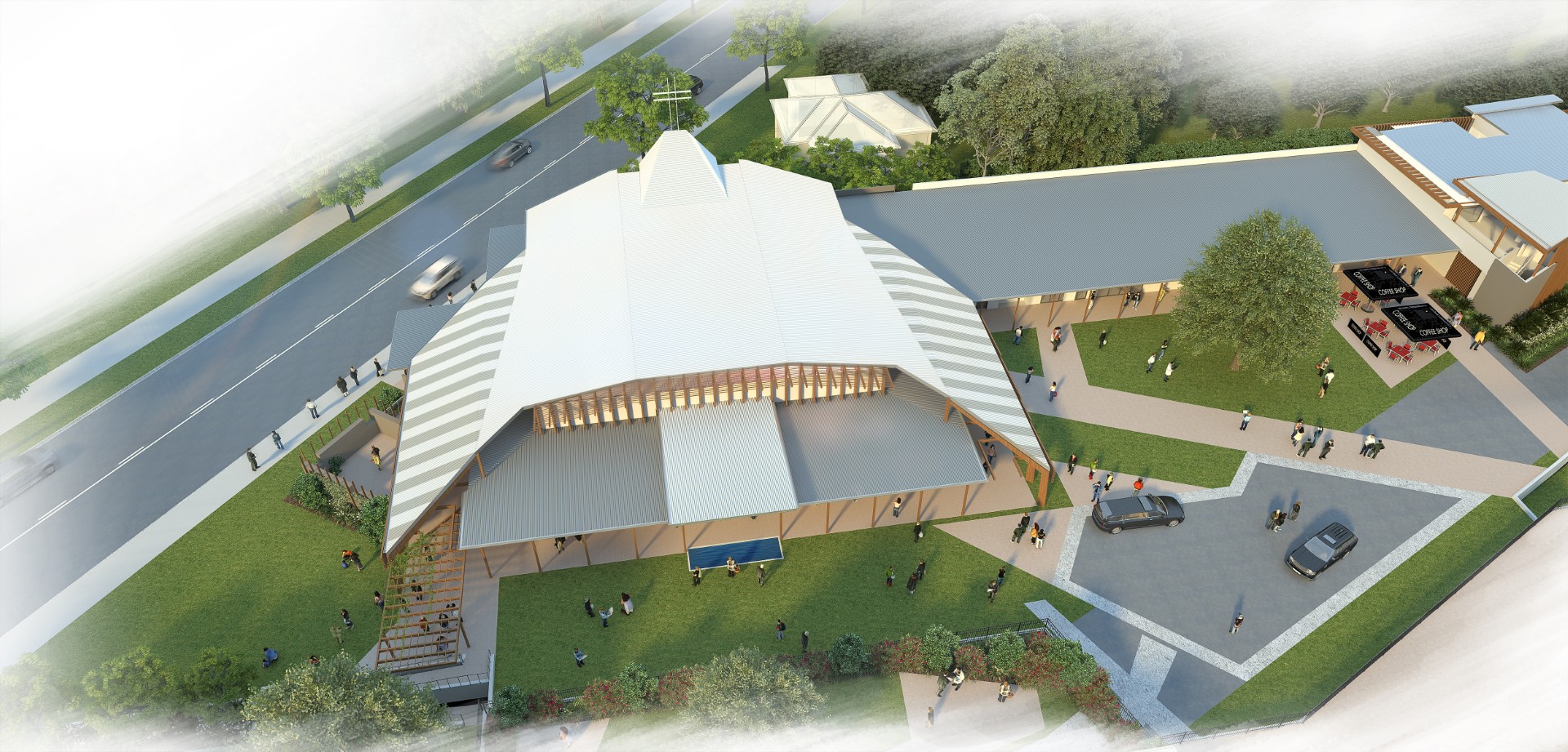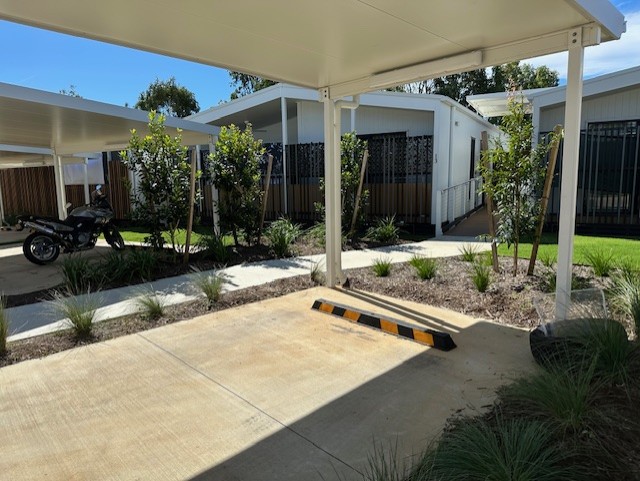
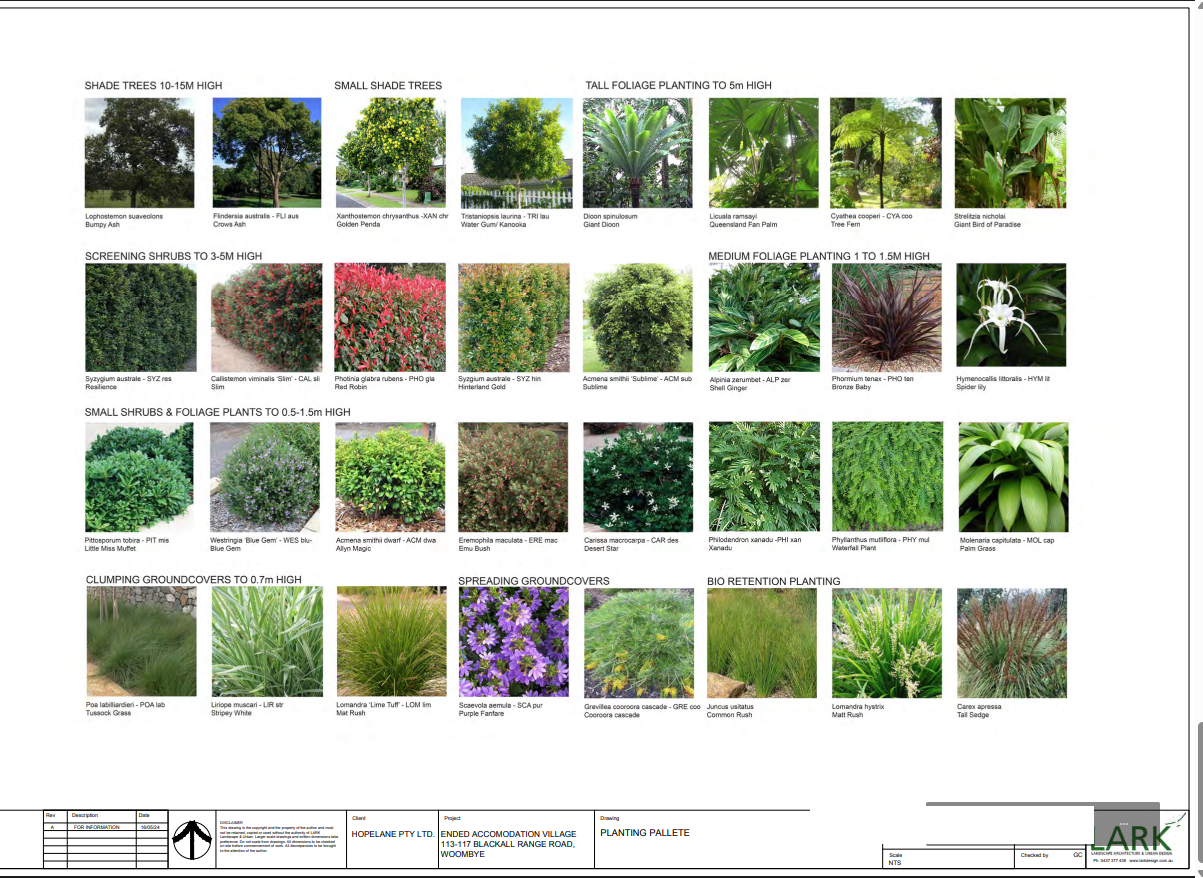
This is a real planting palette from a built Sunshine Coast project — the EndED Accommodation Village at Woombye — grouped the way a landscape architect actually specifies plants: by role in the landscape and by mature size. Use it as a shortcut when you're briefing a designer, writing a maintenance schedule or trying to work out what will actually thrive on a subtropical Queensland site.
How this palette is organised
A planting schedule isn't a plant wish-list — it's a job description. Each species below is grouped by what it does in the landscape (shade, screen, foliage, groundcover, stormwater treatment) and by how tall it gets. That's how planting plans are drawn and how contractors price them.
Shade trees 10–15m high
Use these where you need real canopy shade over lawn, car parks, play space or north-facing living areas. All are proven on Sunshine Coast sites from the coast to the hinterland.
- Bumpy Ash — Lophostemon suaveolens. Local rainforest tree, tolerates wet feet, good habitat.
- Crows Ash — Flindersia australis. Tough, straight-trunked shade tree for streetscapes and parks.
Small shade trees
For courtyards, front gardens and narrow streetscape verges where a 15m tree is too much.
- Golden Penda — Xanthostemon chrysanthus. Reliable feature tree, dense yellow flower.
- Water Gum / Kanooka — Tristaniopsis laurina. Handles urban conditions and periodic wet.
Tall foliage planting to 5m
The subtropical layer that gives a Sunshine Coast garden its character. These are the plants that read as "resort" or "hinterland" depending on how they're combined.
- Giant Dioon — Dioon spinulosum
- Queensland Fan Palm — Licuala ramsayi
- Tree Fern — Cyathea cooperi
- Giant Bird of Paradise — Strelitzia nicholai
Screening shrubs to 3–5m
For side boundaries, service yards and screening a neighbour's roof line. Choose based on how formal you want the edge to read.
- Resilience Lilly Pilly — Syzygium australe 'Resilience'. Psyllid-resistant, formal hedge.
- Slim Callistemon — Callistemon viminalis 'Slim'. Narrow footprint bottlebrush, bird attractor.
- Red Robin Photinia — Photinia glabra rubens. Fast, colour-tipped screen.
- Hinterland Gold Lilly Pilly — Syzygium australe 'Hinterland Gold'. Bronze new growth, tight habit.
Medium foliage planting 1–1.5m
The mid-storey — the layer most home gardens skip and then wonder why the garden reads flat.
- Sublime Acmena — Acmena smithii 'Sublime'
- Shell Ginger — Alpinia zerumbet
- Bronze Baby Phormium — Phormium tenax 'Bronze Baby'
- Spider Lily — Hymenocallis littoralis
Small shrubs and foliage 0.5–1.5m
The layer that fills the front of a bed and stops mulch from showing. Mix textures — glossy, silver, fine — for depth.
- Little Miss Muffet Pittosporum — Pittosporum tobira 'Little Miss Muffet'
- Blue Gem Westringia — Westringia 'Blue Gem'
- Alyn Magic Acmena — Acmena smithii dwarf 'Alyn Magic'
- Emu Bush — Eremophila maculata
- Desert Star Carissa — Carissa macrocarpa 'Desert Star'
- Xanadu Philodendron — Philodendron xanadu
- Waterfall Plant — Phyllanthus multiflora
- Palm Grass — Molineria capitulata
Clumping groundcovers to 0.7m
Structural groundcovers for slopes, edges and mass planting.
- Tussock Grass — Poa labillardieri
- Stripey White Liriope — Liriope muscari
- Mat Rush — Lomandra 'Lime Tuff'
Spreading groundcovers
- Purple Fanfare — Scaevola aemula
- Cooroora Cascade Grevillea — Grevillea 'Cooroora Cascade'
Bio-retention planting
For rain gardens, bio-swales and stormwater treatment basins — plants that tolerate periodic wet and short dry spells and are accepted by most Sunshine Coast and SEQ council planting schedules.
- Common Rush — Juncus usitatus
- Matt Rush — Lomandra hystrix
- Tall Sedge — Carex appressa
How to use this palette on your own project
Think of the list as a starting kit — the actual species and quantities in a planting plan depend on aspect, soil, salt exposure, bushfire zone, council street-tree lists and how the space will be used. On a real project a landscape architect maps every plant to a location, spacing and pot size, and issues a schedule the contractor can order and price. If you'd like a proper planting design for a Sunshine Coast site, get in touch — or see how this palette was applied at the EndED Accommodation Village.